
ARTICLES
Post-Operative Knee Replacement – Case Report
History: The patient presented to outpatient physical therapy three days following a left total knee arthroplasty (TKA). At the time of evaluation, the patient had a surgical dressing over the incision, which was closed with surgical glue. He was instructed to remove the dressing after seven days and to follow up with the surgeon at one month post-operatively. During the initial evaluation, the patient reported significant difficulty sleeping, as well as pain and limited ability to bend the knee. He had taken oxycodone and Tylenol earlier that morning and was actively staying ahead of pain using prescribed medications. The patient noted that he had been trying to bear more weight through the operative leg while ambulating and was currently using a walker for support. To manage swelling, he reported regularly icing the knee and keeping it elevated. Prior to surgery, the patient was independent with ambulation and did not require an assistive device.
Functional Limitations:
- Unable to ambulate without walker
- Unable to perform stairs
- Difficulty sleeping
- Unable to perform light activities around the house
Objective Measurements:
- L knee active range of motion 15-55 deg (R knee 0-130 deg). Passive range of motion 10-75 deg
- At Evaluation the patient was unable to independently lift left leg and had poor quad activation.
- 5% Function on Lower Extremity Functional Scale.
- Gait with rolling walker- decreased weight bearing on left leg, decreased step length, lacking terminal knee extension and lacking knee flexion with swing phase.
- Strength and further functional testing deferred until better pain management
Treatment:
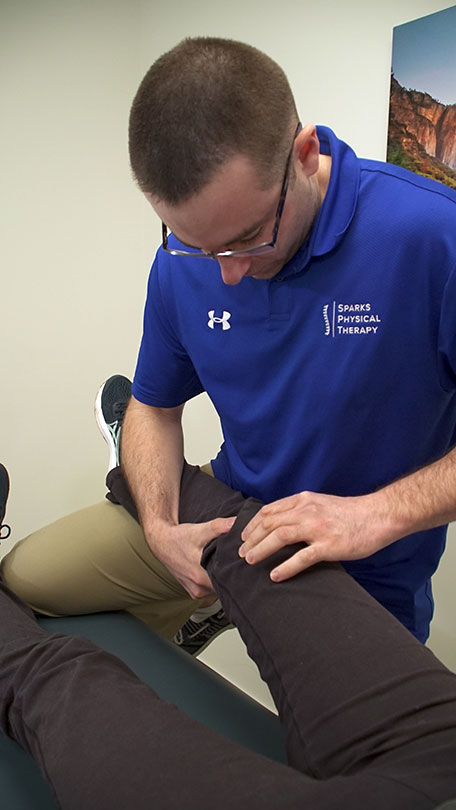
- Manual- Initiated with retrograde massage for swelling management, gentle PROM and gentle joint mobs to improve knee extension and flexion. As pain levels improved and tolerance improved progressed to more aggressive knee flexion and extension mobilizations to optimize range of motion.
- Exercise- Initiated patient with range of motion and stretching to improve knee flexion and extension ROM to be performed 3x/day at home. Progressed with knee and hip strengthening as well as balance training.
- Functional Loading- Immediately started gait training to improve terminal knee extension and knee flexion during swing phase. Once gait normalized with a rolling walker began to wean patients to use a single point cane. Once weaned from the assistive device further trained for movements including stairs, sit to stands and squats.
Results:
- The patient was seen for 17 visits over the course of 7 weeks with the following results:
- L knee active range of motion 0 – 123 degrees
- L knee strength flexion and extension 5/5, hip flexion 5-/5 and hip abduction 4+/5
- Ambulating in home and community and up and down stairs reciprocally without use of assistive device
- L single leg stance for 30 sec.
- 66% function on lower extremity functional scale.
- Patient was able to perform heavier housework and yard work without increased pain.
Related Articles
Bedside Manner: How We Strive for Excellent Patient-Provider Relationships
When seeking medical care, it’s important to find a provider you trust and feel comfortable with. A strong patient-provider relationship not only makes the treatment process more enjoyable, but research has shown that building rapport leads to better outcomes.
Physical Therapy considerations for Pickleball Injuries
Pickleball is a fun and fast-growing sport that blends elements of tennis and ping pong. It’s designed to be low-impact, easy to learn, and accessible to people of all ages and skill levels. But like any sport, pickleball does come with a risk of injury. Fortunately, there are many tips and exercises that can help prepare your body for play and potentially prevent injuries from occurring.
Learn more about Squats
Squats are one of the most fundamental exercises in strength training—whether you’re an athlete training for a sport, someone looking to maintain or improve overall strength, or an older adult aiming to stay independent. Squats help improve both strength and mobility, and they’re highly functional in nature. This compound movement works multiple muscle groups, including the quads, hamstrings, glutes, and core, making it a highly effective full-body exercise. But proper form is key—not only to prevent injury but also to get the most out of each rep.