
ARTICLES
Post-Operative Knee Replacement – Case Report
History: The patient presented to outpatient physical therapy three days following a left total knee arthroplasty (TKA). At the time of evaluation, the patient had a surgical dressing over the incision, which was closed with surgical glue. He was instructed to remove the dressing after seven days and to follow up with the surgeon at one month post-operatively. During the initial evaluation, the patient reported significant difficulty sleeping, as well as pain and limited ability to bend the knee. He had taken oxycodone and Tylenol earlier that morning and was actively staying ahead of pain using prescribed medications. The patient noted that he had been trying to bear more weight through the operative leg while ambulating and was currently using a walker for support. To manage swelling, he reported regularly icing the knee and keeping it elevated. Prior to surgery, the patient was independent with ambulation and did not require an assistive device.
Functional Limitations:
- Unable to ambulate without walker
- Unable to perform stairs
- Difficulty sleeping
- Unable to perform light activities around the house
Objective Measurements:
- L knee active range of motion 15-55 deg (R knee 0-130 deg). Passive range of motion 10-75 deg
- At Evaluation the patient was unable to independently lift left leg and had poor quad activation.
- 5% Function on Lower Extremity Functional Scale.
- Gait with rolling walker- decreased weight bearing on left leg, decreased step length, lacking terminal knee extension and lacking knee flexion with swing phase.
- Strength and further functional testing deferred until better pain management
Treatment:
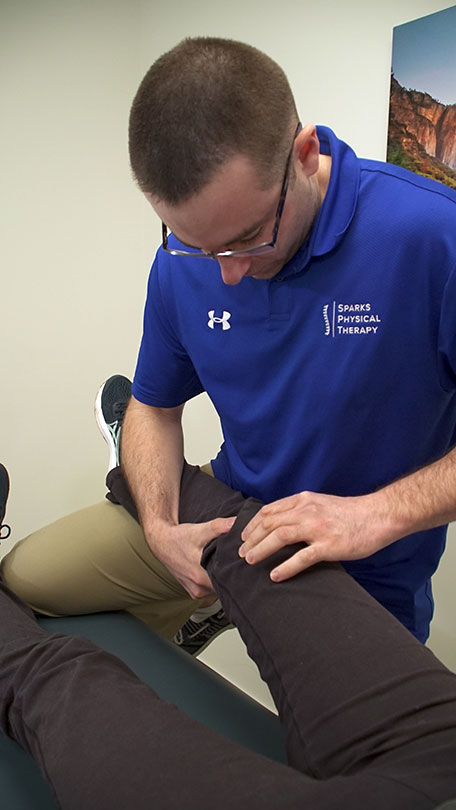
- Manual- Initiated with retrograde massage for swelling management, gentle PROM and gentle joint mobs to improve knee extension and flexion. As pain levels improved and tolerance improved progressed to more aggressive knee flexion and extension mobilizations to optimize range of motion.
- Exercise- Initiated patient with range of motion and stretching to improve knee flexion and extension ROM to be performed 3x/day at home. Progressed with knee and hip strengthening as well as balance training.
- Functional Loading- Immediately started gait training to improve terminal knee extension and knee flexion during swing phase. Once gait normalized with a rolling walker began to wean patients to use a single point cane. Once weaned from the assistive device further trained for movements including stairs, sit to stands and squats.
Results:
- The patient was seen for 17 visits over the course of 7 weeks with the following results:
- L knee active range of motion 0 – 123 degrees
- L knee strength flexion and extension 5/5, hip flexion 5-/5 and hip abduction 4+/5
- Ambulating in home and community and up and down stairs reciprocally without use of assistive device
- L single leg stance for 30 sec.
- 66% function on lower extremity functional scale.
- Patient was able to perform heavier housework and yard work without increased pain.
Related Articles
Constipation in Pediatrics
Constipation in children is very common—research shows that about 1 in 20 pediatrician visits relate to constipation. It often begins around major life transitions, such as starting solid foods, potty training, or beginning school. Many parents may not realize their child is constipated because the child is still passing stool occasionally, and sometimes the stool remains soft.
Pain Neuroscience Education
Pain neuroscience education (PNE) helps individuals in pain understand the underlying neurobiology and neurophysiology behind their pain experience. This education has been shown to reduce self-reported pain, decrease disability, alleviate fear and fear-avoidance behaviors, lessen pain catastrophizing, and improve movement.
Special Considerations for Physical Therapy Treatment of Common Soccer Injuries
Optimum return from any sports injury doesn’t mean returning as quickly as possible. An athlete who goes back to sport without restoring functional stability faces a higher risk of re-injury and poor outcomes.