
ARTICLES
Post-op from a Hip Replacement – Case Report
History: The patient is a 71-year-old female presenting to outpatient physical therapy following a left total hip replacement (THR). She has a medical history significant for a prior left total knee replacement, which did not result in full recovery of motion and continues to limit her function. Following her THR, the patient received home physical therapy for one week. She initiated outpatient therapy just over one week post-operatively, the day after her follow-up appointment with the orthopedic surgeon. At that visit, she was cleared to transition from a walker to a cane, though she reported experiencing slightly increased soreness since making the change. The patient had discontinued prescription pain medications and is unable to take NSAIDs due to other medical conditions. She reported increased back discomfort after sitting for approximately two hours while volunteering at her church, but otherwise described her pain levels as manageable. At home, the patient has 14 steps with a railing and continues to ascend and descend the stairs using a one-step-at-a-time pattern. She was able to clearly articulate her hip precautions and was advised by her surgeon to maintain those precautions for an additional six weeks. The patient’s long-term goal is to return to bowling.
Functional Limitations:
- Restless sleep (trying to sleep on her back however patient is a side sleeper)
- Prolonged walking
- Stairs
- Bending forward
- Unable to perform recreational activities including bowling
Objective Findings:
- Active Range of motion- L knee 10 deg of extension to 95 deg of flexion. L hip flexion 75 deg and abduction 20deg.
- Strength- L hip flexion ⅘, external rotation 4-/5, internal rotation ⅘, abduction ⅘, L quad 5/5
- Balance- single leg stance L 2sec R 10sec
- Gait-normal with use of SPC; antalgic without proper weight bearing on L without SPC
- Observation- warmth and swelling surrounding L hip and incisional area
Treatments:
- Manual Therapy – Started with PROM to L hip within hip precautions and soft tissue mobilization to distal quad and ITB. PROM to L knee with ability for greater pressure and mobilizations and quad stretching. Fairly quickly as the patient improved moved away from manual therapy and focused on strengthening.
- Exercises
- Patient was initiated with gentle hip strengthening in standing and encouraged to start a walking program at just 5 min a day, continuing to use her cane for normalized gait.
- Strengthening focus on hip abduction and ER strengthening, including sidelying leg raises, clams, standing hip abduction/extension with band and bridge.
- Additional focus on quad and hamstring stretching due to limited L knee AROM and past history of TKR.
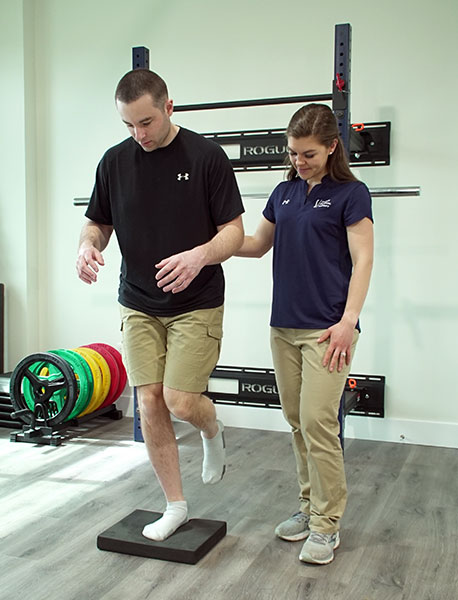
- Balance training including tandem stance and single leg stance
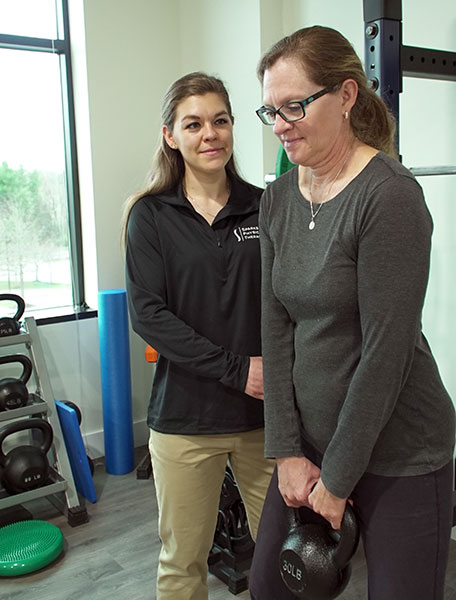
- Began functional loading immediately with sit to stands. Progressed to a hip hinge with weight continuing to adhere to hip precautions. Once strength and balance improved, loading focused on stability with posterior lunge in order to prepare for return to bowling.
Results: Patient was seen for 12 visits over the course of 6 weeks. The patient had achieved the following milestones at the end of her course of treatment.
- L knee AROM improved to 5-108 degrees with significant improvement in extension since starting PT. Patient continued to have significant flexion limitations due to previous TKR.
- Strength was at a 5/5 in all directions except external rotation at 4+/5. Patient was familiar with specific exercises to continue to focus on this area and was independent with the home program for continued strengthening.
- Patient balance improved so she was able to single leg stance on foam for 30sec.
- Patient was walking without an assistive device and without any pain. Occasionally had difficulty with inclines.
- Patient was doing stairs in a reciprocal manner without pain
- Patient continued to have to adjust throughout the night but had been able to lie on her L side some.
- Patient had been able to repetitively practiced motion of bowling without pain however had not yet tried bowling upon discharge.
Related Articles
Bedside Manner: How We Strive for Excellent Patient-Provider Relationships
When seeking medical care, it’s important to find a provider you trust and feel comfortable with. A strong patient-provider relationship not only makes the treatment process more enjoyable, but research has shown that building rapport leads to better outcomes.
Physical Therapy considerations for Pickleball Injuries
Pickleball is a fun and fast-growing sport that blends elements of tennis and ping pong. It’s designed to be low-impact, easy to learn, and accessible to people of all ages and skill levels. But like any sport, pickleball does come with a risk of injury. Fortunately, there are many tips and exercises that can help prepare your body for play and potentially prevent injuries from occurring.
Learn more about Squats
Squats are one of the most fundamental exercises in strength training—whether you’re an athlete training for a sport, someone looking to maintain or improve overall strength, or an older adult aiming to stay independent. Squats help improve both strength and mobility, and they’re highly functional in nature. This compound movement works multiple muscle groups, including the quads, hamstrings, glutes, and core, making it a highly effective full-body exercise. But proper form is key—not only to prevent injury but also to get the most out of each rep.