
ARTICLES
Post-op from a Hip Replacement – Case Report
History: The patient is a 71-year-old female presenting to outpatient physical therapy following a left total hip replacement (THR). She has a medical history significant for a prior left total knee replacement, which did not result in full recovery of motion and continues to limit her function. Following her THR, the patient received home physical therapy for one week. She initiated outpatient therapy just over one week post-operatively, the day after her follow-up appointment with the orthopedic surgeon. At that visit, she was cleared to transition from a walker to a cane, though she reported experiencing slightly increased soreness since making the change. The patient had discontinued prescription pain medications and is unable to take NSAIDs due to other medical conditions. She reported increased back discomfort after sitting for approximately two hours while volunteering at her church, but otherwise described her pain levels as manageable. At home, the patient has 14 steps with a railing and continues to ascend and descend the stairs using a one-step-at-a-time pattern. She was able to clearly articulate her hip precautions and was advised by her surgeon to maintain those precautions for an additional six weeks. The patient’s long-term goal is to return to bowling.
Functional Limitations:
- Restless sleep (trying to sleep on her back however patient is a side sleeper)
- Prolonged walking
- Stairs
- Bending forward
- Unable to perform recreational activities including bowling
Objective Findings:
- Active Range of motion- L knee 10 deg of extension to 95 deg of flexion. L hip flexion 75 deg and abduction 20deg.
- Strength- L hip flexion ⅘, external rotation 4-/5, internal rotation ⅘, abduction ⅘, L quad 5/5
- Balance- single leg stance L 2sec R 10sec
- Gait-normal with use of SPC; antalgic without proper weight bearing on L without SPC
- Observation- warmth and swelling surrounding L hip and incisional area
Treatments:
- Manual Therapy – Started with PROM to L hip within hip precautions and soft tissue mobilization to distal quad and ITB. PROM to L knee with ability for greater pressure and mobilizations and quad stretching. Fairly quickly as the patient improved moved away from manual therapy and focused on strengthening.
- Exercises
- Patient was initiated with gentle hip strengthening in standing and encouraged to start a walking program at just 5 min a day, continuing to use her cane for normalized gait.
- Strengthening focus on hip abduction and ER strengthening, including sidelying leg raises, clams, standing hip abduction/extension with band and bridge.
- Additional focus on quad and hamstring stretching due to limited L knee AROM and past history of TKR.
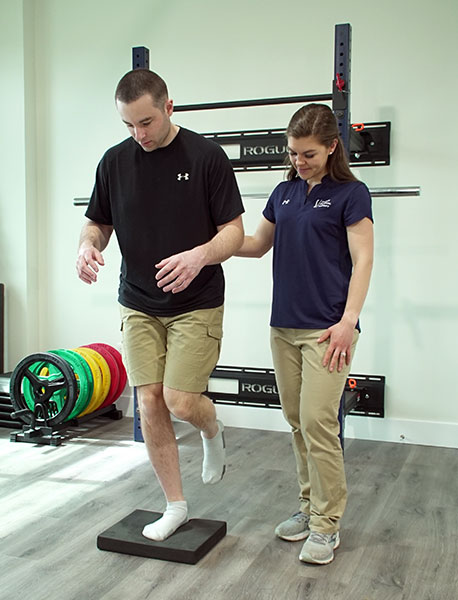
- Balance training including tandem stance and single leg stance
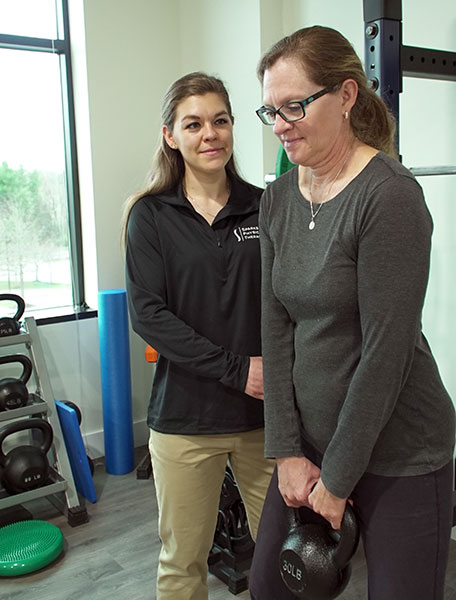
- Began functional loading immediately with sit to stands. Progressed to a hip hinge with weight continuing to adhere to hip precautions. Once strength and balance improved, loading focused on stability with posterior lunge in order to prepare for return to bowling.
Results: Patient was seen for 12 visits over the course of 6 weeks. The patient had achieved the following milestones at the end of her course of treatment.
- L knee AROM improved to 5-108 degrees with significant improvement in extension since starting PT. Patient continued to have significant flexion limitations due to previous TKR.
- Strength was at a 5/5 in all directions except external rotation at 4+/5. Patient was familiar with specific exercises to continue to focus on this area and was independent with the home program for continued strengthening.
- Patient balance improved so she was able to single leg stance on foam for 30sec.
- Patient was walking without an assistive device and without any pain. Occasionally had difficulty with inclines.
- Patient was doing stairs in a reciprocal manner without pain
- Patient continued to have to adjust throughout the night but had been able to lie on her L side some.
- Patient had been able to repetitively practiced motion of bowling without pain however had not yet tried bowling upon discharge.
Related Articles
Pelvic Floor PT/OT Interoception
Interoception is not a word that many people are familiar with, but it can be a key part in helping both adult and pediatric pelvic floor clients learn to address their pelvic floor symptoms and independently manage their pelvic floor needs during and after discharge from therapy.
Urinary Leakage and Incontinence
Urinary leakage and incontinence can occur for many different reasons. Some people leak urine in response to an increase in pressure in the abdomen either from a laugh, sneeze, or cough or from lifting, jumping, or running. Other people leak in response to a sudden, uncontrollable urge to urinate or a “bossy bladder.” As pelvic floor therapists, we treat and approach these kinds of incontinence differently.
Pelvic Floor PT/OT Diaphragm and Pelvic Floor Connection
The relationship between the pelvic floor and the diaphragm is often important when considering conditions like urinary incontinence, constipation, pelvic organ prolapse, and diastasis recti. When thinking about the abdomen like a canister, the pelvic floor is at the bottom of the canister and supports the abdominal contents and pelvic organs (rectum, uterus, and bladder) from the bottom.